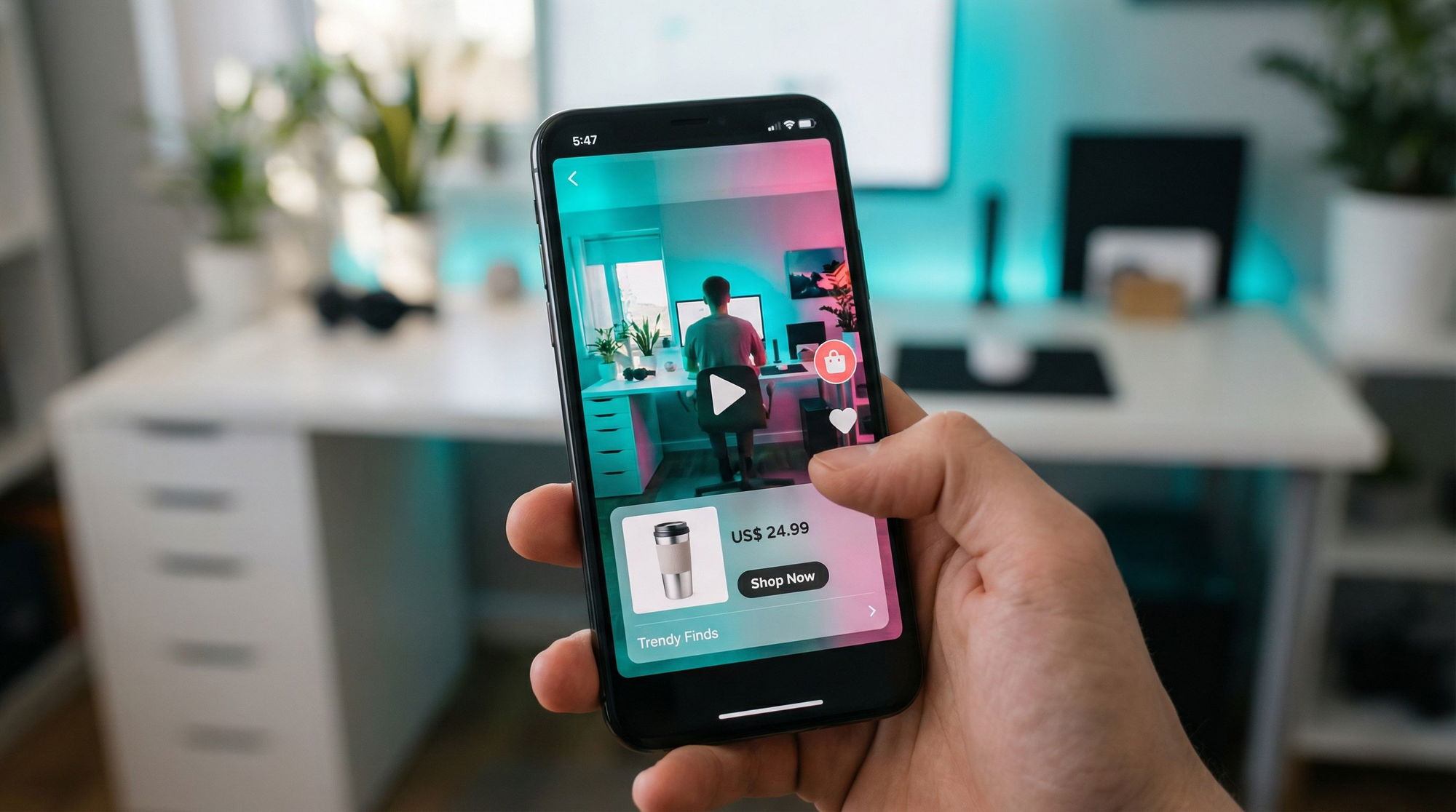
TikTok Shop has moved from an experiment to a revenue channel that ecommerce brands cannot afford to ignore. In 2026, TikTok's in-app commerce ecosystem processes billions in transactions, and the brands capturing the most value are not simply repurposing their Meta ads. They are building TikTok-native creative strategies with ad formats designed specifically for in-feed shopping behavior. This guide breaks down every TikTok Shop ad format that matters, shows you the real benchmarks, and explains how to build a production system that keeps up with TikTok's pace without burning out your team.
Table of Contents
- TikTok Shop ad formats explained
- Real benchmarks: TikTok Shop vs standard traffic ads
- Creative best practices: UGC vs polished
- Building a TikTok Shop content engine
- Common TikTok Shop mistakes that waste budget
- Why TikTok Shop rewards speed over polish
- How Larven powers your TikTok Shop strategy
- Frequently asked questions
Key Takeaways
| Point | Details |
|---|---|
| Video Shopping Ads dominate | Video Shopping Ads deliver the highest conversion rates of any TikTok Shop format for ecommerce. |
| UGC outperforms polished creative | Authentic, creator-style content converts 2x to 3x better than studio-produced ads on TikTok. |
| Refresh every 5 to 7 days | TikTok's algorithm fatigues creative faster than Meta. Weekly refresh is the minimum cadence. |
| AI bridges the production gap | Catalog-connected AI tools generate TikTok-native creatives at the velocity the platform demands. |
TikTok Shop ad formats explained
TikTok Shop offers three primary ad formats for ecommerce brands, each suited to different campaign objectives and funnel stages.
Video Shopping Ads (VSA). These are in-feed video ads with a product card attached at the bottom. When a user taps the card, they can browse and purchase without leaving TikTok. VSAs are the workhorse format for most ecommerce brands because they combine the engagement of native TikTok video with a frictionless checkout path. They work across prospecting and retargeting campaigns.
LIVE Shopping Ads. These promote your TikTok LIVE sessions to targeted audiences, driving viewers into a live commerce experience where they can purchase in real time. LIVE Shopping works best for product launches, flash sales, and categories where demonstration matters (beauty, kitchen, fitness). The format requires a host and real-time inventory management, making it more operationally complex than VSA.
Product Shopping Ads (PSA). These are catalog-driven ads that dynamically serve product images from your TikTok Shop catalog. They function similarly to Meta's Dynamic Product Ads. PSA is most effective for retargeting users who have already visited your shop or viewed a product, closing the loop on warm traffic.
| Format | Best for | Creative requirement | Funnel stage |
|---|---|---|---|
| Video Shopping Ads | Prospecting and retargeting | Short-form video (15 to 30 seconds) | Full funnel |
| LIVE Shopping Ads | Product launches, flash sales | Live host, real-time demo | Mid to bottom funnel |
| Product Shopping Ads | Retargeting warm traffic | Catalog feed with product images | Bottom funnel |
Most ecommerce brands should start with Video Shopping Ads as the primary format, add Product Shopping Ads for retargeting, and test LIVE Shopping only once they have the operational infrastructure to support it. Trying to run all three simultaneously without the right team and tools is a common reason brands underperform on TikTok Shop.
Pro Tip: Video Shopping Ads with a product card achieve significantly higher add-to-cart rates than standard in-feed traffic ads because the purchase path stays inside TikTok. Reducing the number of steps between ad and checkout is the single biggest conversion lever on this platform.
Real benchmarks: TikTok Shop vs standard traffic ads
One of the biggest mistakes brands make is evaluating TikTok Shop performance using Meta benchmarks. The platforms behave differently, and the metrics reflect that.
| Metric | TikTok Shop (Video Shopping Ads) | TikTok standard traffic ads | Meta ASC (for reference) |
|---|---|---|---|
| Average CPM | $6 to $9 | $8 to $12 | $10 to $14 |
| Average CPC | $0.30 to $0.60 | $0.50 to $1.00 | $0.80 to $1.50 |
| Conversion rate | 2.5% to 4.5% | 1.0% to 2.0% | 2.0% to 3.5% |
| Typical ROAS | 2x to 4x | 1.2x to 2x | 3x to 5x |
| Creative lifespan | 5 to 7 days | 5 to 7 days | 7 to 14 days |
Video Shopping Ads outperform standard TikTok traffic ads on nearly every metric because the in-app checkout eliminates the redirect friction that kills conversion on external landing pages. The CPM is also lower because TikTok incentivizes advertisers to keep transactions within its ecosystem.
The key nuance: TikTok Shop ROAS may appear lower than Meta at first glance, but the customer acquisition cost is significantly cheaper. Brands using TikTok Shop for top-funnel acquisition and Meta for retargeting see the strongest blended ROAS. For more on this two-platform approach, the 2026 ecommerce trends breakdown covers the strategic framework in detail.
Creative best practices: UGC vs polished
TikTok's algorithm and user behavior both favor content that feels native to the platform. Studio-produced ads with heavy branding, motion graphics, and voiceover narration consistently underperform compared to creator-style content that looks like an organic post.
What works on TikTok Shop in 2026:
- UGC-style testimonials where a creator speaks directly to camera about the product. Conversion rates on these are 2x to 3x higher than polished brand videos.
- Product-in-hand demonstrations showing the product being unboxed, used, or compared side by side. These build trust faster than lifestyle shots.
- Hook-first structure where the first 2 seconds contain a bold claim, question, or visual disruption. TikTok's swipe behavior means you have less time than any other platform to stop the scroll.
- Vertical 9:16 format only. Horizontal or square creative gets penalized by the algorithm and ignored by users. Every asset must be native vertical.
What underperforms on TikTok Shop:
- Overly branded intros with logo animations
- Static product images repurposed as video slideshows
- Long-form content over 30 seconds for prospecting campaigns
- Reused Meta ads without TikTok-native editing
Pro Tip: Record three variations of every UGC script with different opening hooks. Upload all three and let TikTok's algorithm pick the winner. The cost of producing one extra variation is negligible compared to the potential performance lift.
For a deeper comparison of AI tools that generate UGC-style video at scale, the AI video ad comparison on Larven's blog is a useful reference.
Building a TikTok Shop content engine
The biggest operational challenge with TikTok Shop is creative velocity. The platform fatigues content faster than Meta, which means you need a production system that delivers 5 to 10 new video assets every week without fail.
A repeatable weekly production workflow:
- Monday: Data review. Analyze the past week's performance. Identify which hooks, formats, and products drove the strongest add-to-cart and conversion rates. Flag any creatives approaching fatigue (CTR declining for 3+ consecutive days).
- Tuesday: Brief and source. Write creative briefs based on Monday's data. For UGC, send briefs to your creator roster or AI generation tool. For product demos, queue catalog assets for AI video creation.
- Wednesday to Thursday: Production. Creators deliver raw footage or AI generates finished assets from your product feed. Run a lightweight brand compliance review (24-hour maximum turnaround).
- Friday: Deploy. Upload approved assets to TikTok Ads Manager. Structure Video Shopping Ad groups with 3 to 5 creatives each. Set initial budgets and let the algorithm begin testing over the weekend.
- Weekend: Monitor. Check for early performance signals. Pause any creative that shows CPM significantly above account average after 48 hours of delivery.
This cadence is sustainable for teams of two to three people when supported by AI creative tools. Without AI, the same workflow requires a dedicated production team or an agency retainer that most mid-sized brands cannot justify.
Pro Tip: Maintain a library of 20 to 30 proven hook templates. When performance data tells you a product angle is working, you can swap hooks on existing scripts rather than starting creative from scratch every week.
Common TikTok Shop mistakes that waste budget
- Sending traffic to external landing pages instead of TikTok Shop checkout. Every redirect step costs roughly 40% of your traffic. The entire point of TikTok Shop ads is keeping the purchase inside the app.
- Using Meta creative without adaptation. Meta and TikTok audiences respond to fundamentally different creative styles. A polished carousel that converts on Instagram will often get scrolled past instantly on TikTok.
- Running the same creative for more than 7 days. TikTok's algorithm deprioritizes stale assets faster than Meta. By day 7, most creatives are delivering to a saturated segment at rising CPMs.
- Ignoring Spark Ads. Spark Ads let you boost organic creator posts as paid ads, maintaining social proof (likes, comments, shares). Brands that skip Spark Ads miss one of TikTok's most effective ad formats for building trust at scale.
- Not connecting your product catalog. Without a connected catalog, Product Shopping Ads and dynamic retargeting are not available. This leaves significant bottom-funnel revenue on the table.
"The brands failing on TikTok Shop are the ones treating it like another Meta placement. TikTok is a different platform with different rules. Respect the format or waste the budget."
Why TikTok Shop rewards speed over polish
There is a counterintuitive truth about TikTok Shop that many brands resist: imperfect content published fast consistently outperforms perfect content published slowly. The platform's algorithm is designed to test and surface new content rapidly. A video shot on an iPhone with good lighting and a strong hook will outperform a $5,000 studio production nine times out of ten.
This is not an argument for low-quality content. It is an argument for prioritizing authenticity and speed over production value. The brands winning on TikTok Shop have internalized this distinction. They invest in systems that produce good content fast rather than great content slowly.
AI-powered creative tools make this practical at scale. When a platform can generate a TikTok-native UGC-style video from your product catalog in minutes, the cost of testing a new angle drops to nearly zero. You can run ten creative experiments for the budget that would have funded one traditional production cycle.
How Larven powers your TikTok Shop strategy
Larven connects to your product catalog and generates TikTok-native video, UGC-style, and static ad creatives automatically. The platform deploys directly to TikTok Ads Manager, handles format resizing, and monitors creative fatigue so assets get replaced before performance drops.
For ecommerce brands building a TikTok Shop strategy, Larven functions as an AI CMO that handles the creative velocity TikTok demands while your team focuses on product and strategy. See real results from brands using Larven, or join the waitlist to get early access.
Frequently asked questions
Which TikTok Shop ad format converts best for ecommerce?
Video Shopping Ads deliver the highest conversion rates because the product card enables in-app checkout without redirecting users to an external site. Start with VSA for prospecting and add Product Shopping Ads for retargeting.
How often should I refresh TikTok Shop creative?
Every 5 to 7 days. TikTok's algorithm fatigues creative faster than Meta, and running assets beyond 7 days almost always results in rising CPMs and declining conversion rates.
Does UGC really outperform polished video on TikTok Shop?
Yes. UGC-style content with creators speaking to camera converts 2x to 3x better than studio-produced brand videos on TikTok. The platform rewards content that feels native and authentic.
Can I reuse my Meta ads on TikTok Shop?
Not without significant adaptation. Meta creative styles (polished, branded, horizontal) underperform on TikTok. Assets need to be vertical 9:16, hook-first, and authenticity-driven to work on the platform.
Recommended
Turn this into a live campaign.
Tell Atlas what you're promoting and watch the batch appear.