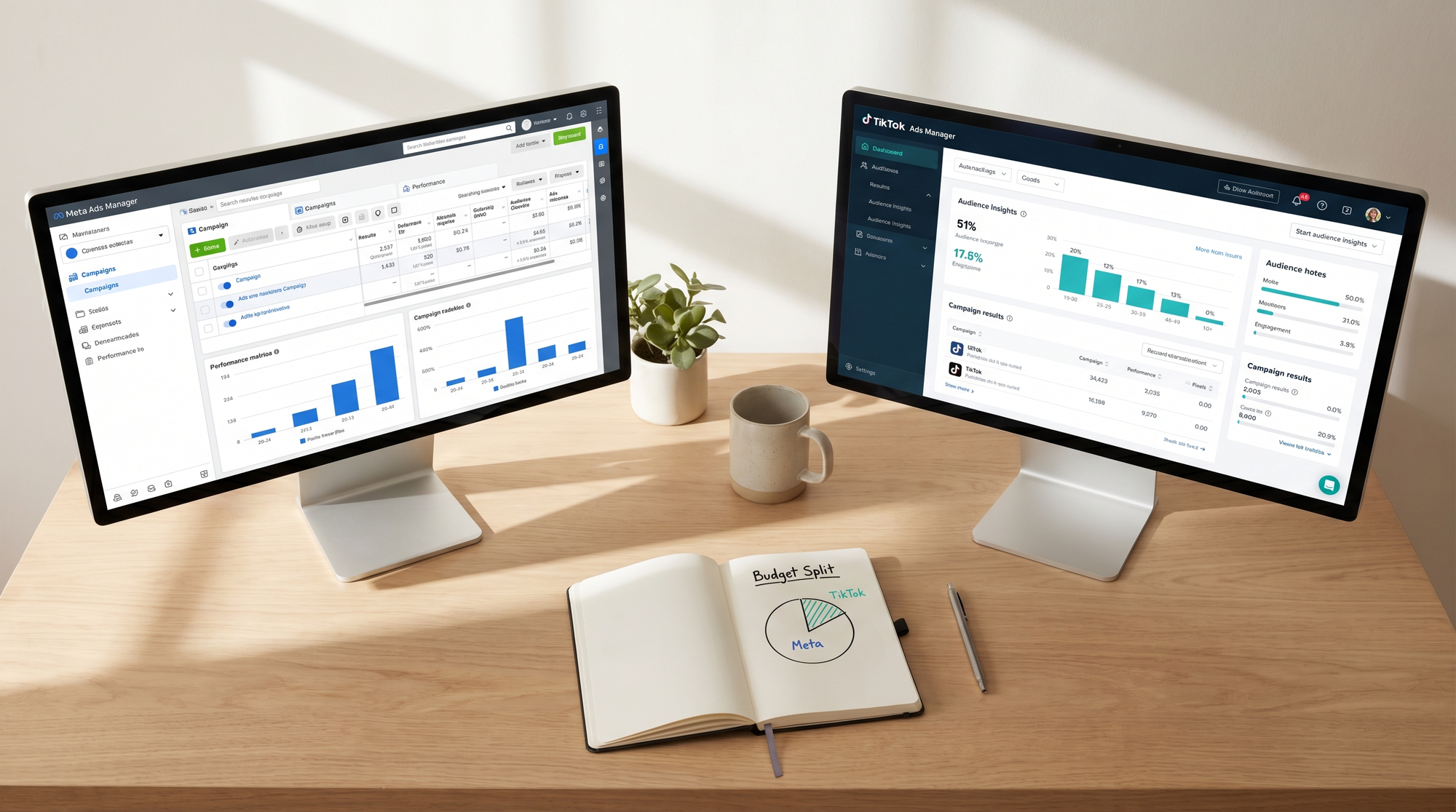
You have $5,000 to spend on ads for your ecommerce store. The question every founder and marketing manager asks: should it go to Meta, TikTok, or both? The answer depends on your product category, average order value, creative capacity, and where your audience actually converts. In 2026, both platforms are viable acquisition channels, but they serve different roles in a growth strategy. Splitting budget evenly without understanding these differences is one of the most common mistakes early-stage brands make. This guide gives you a week-by-week framework for allocating your first $5,000, explains the benchmarks you should expect at each stage, and tells you exactly when it makes sense to add the second platform.
Table of Contents
- Start with one platform, not two
- Which platform to choose first
- Week-by-week budget allocation framework
- Expected benchmarks at each stage
- When to add the second platform
- Creative requirements for a $5,000 budget
- The biggest mistakes brands make with their first $5,000
- How Larven makes $5,000 perform like $50,000
- Frequently asked questions
Key Takeaways
| Point | Details |
|---|---|
| Start with one platform | Splitting $5,000 across two platforms dilutes data and slows learning. Pick one, learn fast, then expand. |
| Product category determines platform | Fashion, beauty, and impulse purchases favor TikTok. Higher AOV and considered purchases favor Meta. |
| 4-week ramp is the minimum | Expect 2 weeks of learning phase before meaningful performance data starts emerging. |
| Creative volume is the constraint | $5,000 in ad spend with 3 creatives will underperform $3,000 with 15 creatives every time. |
Start with one platform, not two
The instinct to diversify immediately is understandable but counterproductive at this budget level. $5,000 split between Meta and TikTok gives you $2,500 per platform. At $2,500, neither platform's algorithm has enough budget to exit the learning phase efficiently. You end up with noisy data from both channels, no clear signal about what works, and a temptation to draw conclusions from statistically insignificant results.
$5,000 concentrated on one platform gives the algorithm roughly $170 per day over 30 days. That is enough for Meta's Advantage+ to test 5 to 8 creative and audience combinations with reasonable statistical confidence. On TikTok, the same budget gives you enough runway for 3 to 4 rounds of creative testing with measurable conversion data.
The goal at this stage is not diversification. It is signal. You need to learn which product angles resonate, which creative formats convert, and what your baseline CPA looks like on a single platform before introducing the complexity of a second channel.
Pro Tip: Think of your first $5,000 as a research budget, not a revenue budget. The data you collect in the first 30 days determines whether your next $10,000 scales profitably or gets wasted repeating the same experiments.
Which platform to choose first
The decision is not about which platform is "better." It is about which platform is better for your specific product, audience, and creative capacity right now.
| Factor | Choose Meta first | Choose TikTok first |
|---|---|---|
| Average order value | $50+ (considered purchases) | Under $50 (impulse friendly) |
| Product category | Home, electronics, premium apparel, supplements | Fashion, beauty, accessories, novelty, food |
| Target demographic | 25 to 55 year olds | 18 to 35 year olds |
| Creative assets available | Mix of static and video | Primarily short-form vertical video |
| Existing social presence | Facebook/Instagram following | TikTok following or creator network |
| Conversion goal | Website purchases with multi-step consideration | In-app purchases (TikTok Shop) or impulse buys |
If your product is a $35 skincare set targeting women aged 22 to 30 and you have access to UGC creators, TikTok is the stronger starting platform. If your product is a $120 home gadget targeting homeowners aged 30 to 50 and you have product photography, Meta is the better starting point.
When the decision is genuinely unclear (your product fits both profiles), default to Meta. Meta's Advantage+ campaigns have a more forgiving learning phase, the algorithm performs well with both static and video creative, and the attribution model gives clearer signals for early optimization. You can always add TikTok once you have baseline data from Meta to compare against.
For more on how these platforms compare on cost and strategy, the 2026 ecommerce trends breakdown covers platform benchmarks in detail.
Week-by-week budget allocation framework
This framework assumes you are starting on a single platform with $5,000 over 4 to 5 weeks.
| Week | Daily budget | Focus | Creative count |
|---|---|---|---|
| Week 1 | $75 to $100 | Launch 2 to 3 ad sets with 5 to 8 creatives each. Broad targeting. Learning phase. | 10 to 15 |
| Week 2 | $100 to $130 | Evaluate 2-second view rates and CTR. Pause bottom 30% of creatives. Keep learning. | 10 to 12 active |
| Week 3 | $130 to $170 | Add 5 to 8 new creatives based on week 1 to 2 learnings. Increase budget on top performers. | 12 to 18 active |
| Week 4 | $170 to $220 | Scale winners by 20%. Establish baseline CPA and ROAS. Prepare for platform expansion decision. | 10 to 15 active |
Total spend over 4 weeks: approximately $3,500 to $4,500. The remaining $500 to $1,500 serves as a buffer for week 5 scaling or for seeding a second platform test once you have baseline data.
Week 1 details. Launch with broad targeting (no interest stacking, no narrow custom audiences). Upload 10 to 15 creatives across 2 to 3 ad sets. The algorithm needs variety to test, and restricting it with small audiences or few creatives at this budget slows learning dramatically. Expect high CPM and inconsistent results. This is normal.
Week 2 details. After 7 days of data, sort creatives by 2-second view rate and CTR. Pause anything below your account average on both metrics. Do not make CPA decisions yet. The sample size is too small. Focus on creative performance signals only.
Week 3 details. Brief and produce 5 to 8 new creatives using the hooks, formats, and angles that performed best in weeks 1 and 2. Add these to your campaign. Increase daily budget by 20% on ad sets with the strongest CTR. This is where data-driven iteration starts compounding.
Week 4 details. By now you should have a stable CPA on at least 2 to 3 creatives. Scale these by increasing budget 20% every 3 days. Document your baseline metrics: CPA, ROAS, CTR, CPM. These numbers become your benchmark for evaluating the second platform.
Pro Tip: Do not judge campaign success before day 14. The first two weeks are learning investment. Making budget cuts or strategy changes before you have 14 days of data is the most common way brands waste their first $5,000.
Expected benchmarks at each stage
| Metric | Week 1 to 2 (learning) | Week 3 to 4 (optimization) | Healthy target |
|---|---|---|---|
| CPM (Meta) | $12 to $18 | $9 to $14 | Under $14 |
| CPM (TikTok) | $9 to $14 | $6 to $10 | Under $10 |
| CTR (Meta) | 0.8% to 1.5% | 1.5% to 2.5% | Above 1.5% |
| CTR (TikTok) | 0.5% to 1.2% | 1.0% to 2.0% | Above 1.0% |
| CPA | Unreliable (sample too small) | Stabilizing | Depends on AOV and margin |
| ROAS | Likely below target | Approaching 2x to 3x | 2x+ for most categories |
Do not panic if week 1 ROAS is below 1x. At $75 to $100 per day, you are buying data, not revenue. The algorithm is testing combinations. By week 3, the signal-to-noise ratio improves dramatically, and your cost metrics should trend toward the healthy target column.
When to add the second platform
Add the second platform when all three conditions are met:
- You have a stable CPA on your primary platform that has been consistent for at least 7 days.
- You have at least 5 proven creative concepts that you can adapt (not copy) for the second platform.
- You can allocate at least $1,500 to $2,000 for the second platform's initial 2-week learning phase without reducing your primary platform budget.
For most brands starting at $5,000 total, this means adding the second platform in month 2, once the primary channel is stable and your total monthly budget has increased to $7,000 or more. Trying to run both platforms simultaneously on $5,000 total almost always produces worse results than focusing on one.
When you do add the second platform, allocate it specifically for a different funnel stage. If Meta is your conversion engine, use TikTok for top-funnel awareness. If TikTok is driving low-cost acquisition, use Meta for retargeting and conversion. The TikTok Shop ads guide covers how to structure TikTok-specific campaigns when you are ready to expand.
Creative requirements for a $5,000 budget
At $5,000, creative quality and volume matter more than budget allocation. $5,000 in spend with 3 creatives will underperform $3,000 in spend with 15 creatives every single time. The algorithm needs options to test. With few creatives, it has no room to optimize.
Minimum creative requirements for a $5,000 launch:
- 10 to 15 unique creatives across at least 2 to 3 formats (static image, short video, UGC-style)
- 3 to 5 different hook angles per product to test which message resonates
- Platform-native formatting (9:16 for TikTok, 1:1 and 4:5 for Meta Feed, 9:16 for Stories/Reels)
- 5 to 8 new creatives by week 3 to refresh the pool before initial assets fatigue
Producing 15 to 20 creatives before you even launch sounds overwhelming for a lean team. This is exactly where AI creative tools change the economics. A platform that generates ad creatives from your product catalog can produce 15 to 20 variations in hours, not weeks. For a breakdown of production costs and how AI compresses them, the manual vs AI creative production cost analysis covers the full comparison.
Pro Tip: Prioritize creative volume over creative perfection at this stage. A "good enough" creative that goes live on day 1 generates data that makes your day 14 creative better. A "perfect" creative that launches on day 14 has zero data advantage.
The biggest mistakes brands make with their first $5,000
- Splitting budget across two platforms from day one. $2,500 per platform is not enough for either algorithm to learn effectively. Concentrate, learn, then expand.
- Launching with fewer than 10 creatives. Three creatives gives the algorithm three options. That is not a test. It is a coin flip.
- Using interest-based targeting instead of broad. At $5,000, narrow targeting limits the algorithm's ability to find buyers you did not predict. Broad targeting with strong creative outperforms narrow targeting with average creative at this budget level.
- Judging performance before day 14. The learning phase is real. Making cuts or pivots before 2 weeks of data leads to premature conclusions and wasted spend.
- Not refreshing creative in week 3. Even on a small budget, creative fatigue happens. If your best performer from week 1 is still your only performer in week 4, you are riding a declining asset.
- Chasing ROAS from day one. Your first $5,000 is a data investment. Optimizing for ROAS before you have reliable CPA data leads to premature scaling of the wrong creatives.
"Your first $5,000 buys data, not revenue. The brands that treat it as research outperform the ones that treat it as a sales channel from day one."
How Larven makes $5,000 perform like $50,000
The biggest constraint at $5,000 is not budget. It is creative volume and speed. Larven connects to your product catalog and generates 15 to 20+ ad creatives (static, video, UGC-style) before you spend your first dollar. The platform handles format resizing, deploys directly to Meta or TikTok, and refreshes creatives automatically as performance data comes in.
For founders and lean marketing teams launching their first paid campaigns, Larven functions as an AI CMO that handles the creative production and optimization your budget cannot staff. See real results from brands using Larven, or join the waitlist to get early access.
Frequently asked questions
Should I start with Meta or TikTok for my first ecommerce ads?
It depends on your product. Fashion, beauty, and sub-$50 impulse products favor TikTok. Higher AOV, considered purchases, and audiences aged 25+ favor Meta. When genuinely uncertain, default to Meta because its Advantage+ learning phase is more forgiving for beginners.
How should I split $5,000 between Meta and TikTok?
Do not split it. Concentrate the full $5,000 on one platform for 4 weeks to build reliable data. Add the second platform in month 2 once you have stable CPA, proven creative concepts, and at least $1,500 to $2,000 in additional budget to fund the second platform's learning phase.
How many ad creatives do I need for a $5,000 launch?
Minimum 10 to 15 unique creatives across 2 to 3 formats, with 5 to 8 fresh assets ready for week 3 refresh. Creative volume matters more than budget size. The algorithm needs variety to test and optimize effectively.
When should I expect positive ROAS on my first $5,000?
Most brands see ROAS stabilize toward the end of week 3 or during week 4. Weeks 1 and 2 are learning phase where ROAS is unreliable. Treat the first $5,000 as a data investment that makes your next $10,000 profitable.
Recommended
Turn this into a live campaign.
Tell Atlas what you're promoting and watch the batch appear.