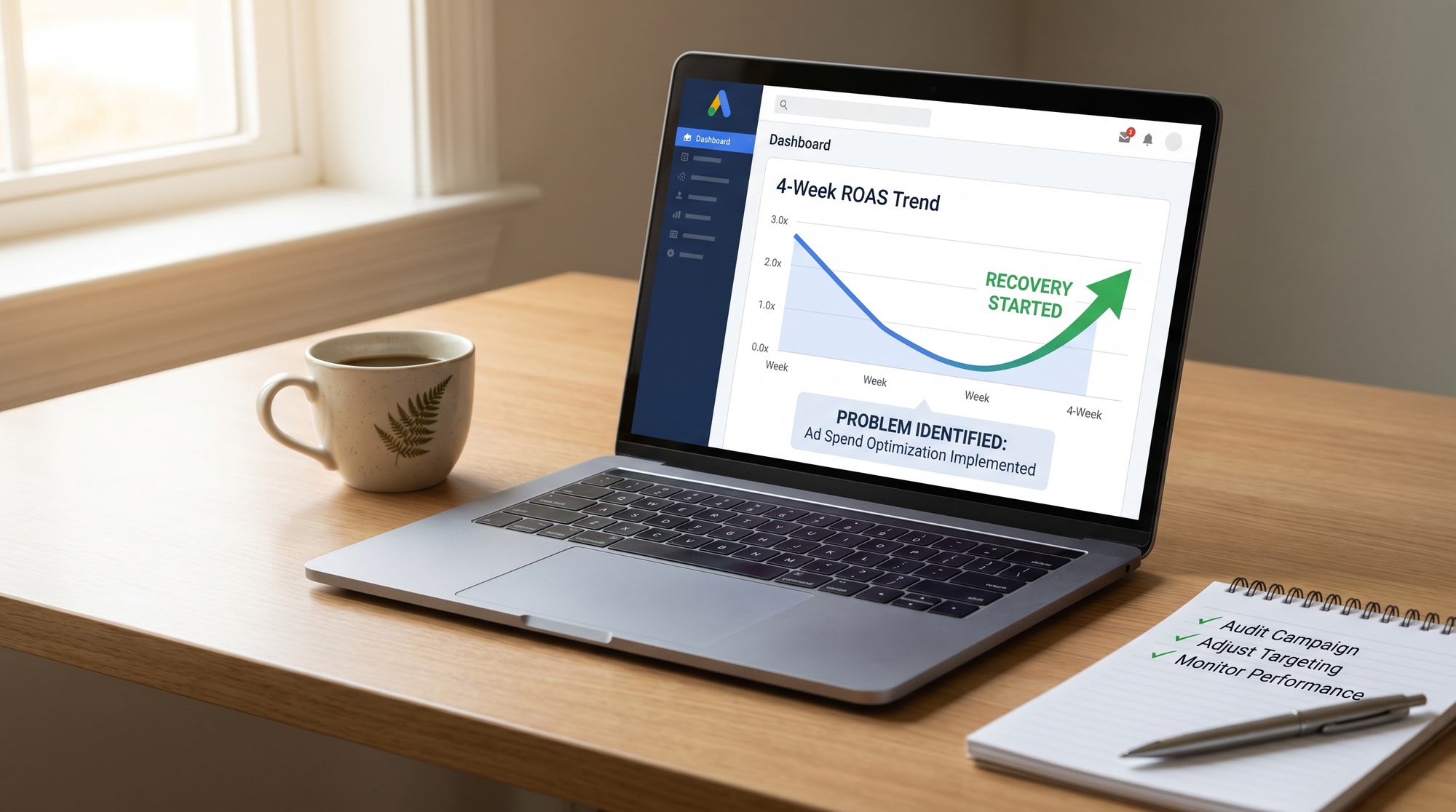
Your ROAS has been slipping for weeks. Maybe months. The campaigns that used to deliver 3x to 4x returns are now hovering around 2x, and nothing you adjust seems to stick. You have tried new audiences, tweaked bids, and refreshed a creative or two, but the decline continues. The problem is that declining ROAS is a symptom, not a diagnosis. Without identifying the root cause, every fix is a guess. This guide walks you through the five most common reasons ecommerce ROAS declines on Meta and TikTok, shows you exactly which metrics reveal which problem, and gives you a 30-day action plan to reverse the trend.
Table of Contents
- The five root causes of declining ecommerce ROAS
- Diagnosing your specific problem
- Root cause 1: Creative fatigue
- Root cause 2: Audience saturation
- Root cause 3: Landing page mismatch
- Root cause 4: Wrong campaign structure
- Root cause 5: Attribution gaps
- The 30-day ROAS recovery plan
- How Larven prevents ROAS decline automatically
- Frequently asked questions
Key Takeaways
| Point | Details |
|---|---|
| ROAS decline has 5 root causes | Creative fatigue, audience saturation, landing page mismatch, campaign structure, and attribution gaps. |
| Metrics reveal the diagnosis | Each root cause produces a distinct pattern in CTR, CPM, frequency, CPC, and conversion rate. |
| Creative fatigue is the #1 cause | Over 60% of gradual ROAS decline in ecommerce campaigns traces back to stale ad creatives. |
| 30 days is enough to recover | A structured 4-week action plan addressing the specific root cause can restore ROAS to previous levels. |
The five root causes of declining ecommerce ROAS
Declining ROAS is not random. It follows predictable patterns caused by specific, identifiable problems. In order of frequency for ecommerce brands running Meta and TikTok campaigns in 2026:
- Creative fatigue. Your ad assets have been shown to the same audiences too many times. Engagement drops, CPM rises, and conversion rates decline. This is the most common cause, responsible for the majority of gradual ROAS erosion.
- Audience saturation. Your target audience has been fully penetrated at the current spend level. The algorithm is forced to reach less qualified users, increasing CPA and reducing ROAS.
- Landing page mismatch. The promise in your ad does not match the experience on your landing page. Users click but do not convert, driving up CPC while tanking conversion rate.
- Wrong campaign structure. Over-segmented ad sets, competing audiences, or incorrectly configured Advantage+ campaigns cause the algorithm to underperform against its potential.
- Attribution gaps. Your ROAS may not actually be declining. Changes in tracking (iOS privacy updates, cookie deprecation, attribution windows) can make performance appear worse than it is.
The critical step most brands skip: diagnosing which cause is driving their specific decline before attempting a fix. Refreshing creative will not solve a landing page problem. Broadening audiences will not fix an attribution gap. Each cause requires a different intervention.
Diagnosing your specific problem
Each root cause produces a distinct fingerprint in your campaign metrics. Here is how to read the signals:
| Metric pattern | Most likely root cause |
|---|---|
| CTR declining, CPM rising, frequency above 2.5 | Creative fatigue |
| CPM rising, CTR stable, CPA rising | Audience saturation |
| CTR stable or healthy, conversion rate dropping | Landing page mismatch |
| Inconsistent delivery, frequent learning phase resets | Campaign structure issues |
| In-platform ROAS declining but revenue stable or growing | Attribution gaps |
Start your diagnosis by pulling these five metrics for the last 30 days: CTR, CPM, frequency, conversion rate, and in-platform ROAS. Compare them to your best-performing 30-day period in the last 6 months. The metric that has changed the most relative to its baseline is your strongest diagnostic signal.
Pro Tip: Do not diagnose at the campaign level. Drill down to the ad set and individual ad level. A campaign-level ROAS decline can mask an ad set that is performing well alongside one that is dragging everything down. The fix is often pausing or restructuring one ad set, not overhauling the entire campaign.
Root cause 1: Creative fatigue
The signal: CTR declining steadily over 7 to 14 days, CPM rising, frequency climbing above 2.5, thumb-stop rate dropping.
Why it happens: Every ad has a finite lifespan. On Meta, most ecommerce creatives begin fatiguing after 7 to 14 days. On TikTok, the window is even shorter at 5 to 7 days. Once an asset has been shown to its optimal audience segment multiple times, engagement drops and the algorithm is forced to expand to less responsive segments at higher cost.
The fix:
- Pause any creative with a CTR decline of 20% or more from its peak
- Add 5 to 10 new creatives immediately, prioritizing different hook frameworks and visual styles
- Establish a weekly creative refresh cadence to prevent fatigue from recurring
- Track creative fatigue rate (speed of CTR decline per asset) to predict replacement timing
Creative fatigue is the root cause that AI tools are specifically designed to solve. A platform that generates ad creatives from your product catalog and refreshes them automatically eliminates the production bottleneck that causes fatigue to go unaddressed. The content creation for automated ads guide covers the full operational framework.
Root cause 2: Audience saturation
The signal: CPM rising while CTR remains relatively stable. CPA increasing. The algorithm is reaching further into marginal audience segments to spend your budget.
Why it happens: At a given budget level, your target audience is finite. Once the algorithm has shown your ads to most of the qualified users in your targeting parameters, it starts expanding to less qualified segments. Each incremental impression costs more and converts less.
The fix:
- Broaden your targeting. Remove interest stacks and let the algorithm prospect more widely
- Expand lookalike seed audiences from 1% to 3% to 5%
- Test new geographies if your fulfillment supports it
- Introduce new creative angles that appeal to adjacent audience segments
- If on Meta, ensure Advantage+ is enabled with broad targeting to give the algorithm maximum room
Saturation is often confused with fatigue because both produce rising CPMs. The difference: fatigue shows declining CTR (people see your ad and ignore it), while saturation shows stable CTR but rising CPM (the platform charges more to reach new people). The fix for fatigue is new creative. The fix for saturation is new audiences.
Root cause 3: Landing page mismatch
The signal: Healthy CTR (people are clicking), but conversion rate on the landing page is declining. Bounce rate may also be rising.
Why it happens: The ad makes a promise (specific product, price, benefit, or offer) that the landing page does not deliver. This can be as obvious as an ad promoting a sale price that is not visible on the landing page, or as subtle as a tone mismatch between a UGC-style ad and a corporate-looking product page.
The fix:
- Audit the top 5 ads by click volume. Visit each linked landing page and compare the message, offer, and visual style
- Ensure price consistency between ad and landing page
- Match the creative style: if the ad is UGC, the landing page should feel authentic, not corporate
- Test dedicated landing pages for top-performing ad angles rather than sending all traffic to a generic product page
- Check mobile load speed. Pages loading over 3 seconds lose 40% or more of mobile traffic
Pro Tip: Use UTM parameters on every ad to track which specific creative sends traffic to which landing page. When conversion rate varies significantly across creatives pointing to the same page, the problem is message match, not page quality.
Root cause 4: Wrong campaign structure
The signal: Inconsistent delivery, frequent learning phase resets, ad sets competing against each other, budget not distributing as expected.
Why it happens: Over-segmented campaign structures (10+ ad sets targeting overlapping audiences) cause internal auction competition. Each ad set bids against your other ad sets for the same users, driving up CPM artificially. Frequent edits (budget changes, audience changes, creative swaps) reset the learning phase, preventing the algorithm from optimizing.
The fix:
- Consolidate ad sets. For most ecommerce brands under $5,000 per day, 2 to 4 ad sets per campaign is optimal
- Use Advantage+ Shopping Campaigns on Meta, which consolidate automatically
- Stop making more than one significant change per ad set per week
- Separate prospecting and retargeting into distinct campaigns to avoid audience overlap
- Let each change run for 72 hours before evaluating
For a detailed guide on structuring campaigns for scale, the ASC scaling guide covers campaign architecture, budget pacing, and structural best practices.
Root cause 5: Attribution gaps
The signal: In-platform ROAS is declining, but actual revenue (Shopify, Stripe, bank deposits) is stable or growing. There is a growing disconnect between what the ad platform reports and what your business actually sees.
Why it happens: Privacy changes (iOS App Tracking Transparency, cookie deprecation, shortened attribution windows) have progressively reduced the ad platform's ability to track conversions accurately. Meta's default 7-day click, 1-day view window misses conversions that happen after that window. TikTok's attribution is even more limited for website purchases outside TikTok Shop.
The fix:
- Compare in-platform ROAS with blended ROAS (total revenue divided by total ad spend) weekly
- Implement Conversions API (CAPI) on Meta and Events API on TikTok for server-side tracking
- Use UTM-based tracking in Google Analytics 4 as a secondary attribution source
- Consider a multi-touch attribution tool if your monthly spend exceeds $10,000
- Do not make budget decisions based solely on in-platform ROAS. Always cross-reference with actual revenue data
Attribution gaps do not require campaign changes. They require measurement changes. If your revenue is healthy but in-platform metrics look poor, the problem is the measurement, not the campaigns.
The 30-day ROAS recovery plan
| Week | Actions |
|---|---|
| Week 1: Diagnose | Pull 30-day metrics. Compare to best-performing period. Identify root cause using the diagnostic table. Audit top 10 creatives, landing pages, and campaign structure. |
| Week 2: Intervene | Apply the specific fix for your diagnosed root cause. Pause fatigued creatives. Launch 5 to 10 new assets. Fix landing page mismatches. Consolidate ad sets if structural. |
| Week 3: Optimize | Evaluate intervention results after 7 days. Scale winning new creatives by 20% budget increase. Pause underperformers. Add second round of fresh creative if fatigue was the cause. |
| Week 4: Systematize | Document what worked. Set up automated rules for fatigue detection. Establish weekly creative refresh cadence. Build a reusable diagnostic checklist for future declines. |
The most important output of this 30-day plan is not just recovered ROAS. It is a system that prevents the same decline from happening again. Every ROAS recovery should produce a documented process that becomes your team's standard operating procedure for performance monitoring.
"Declining ROAS is not a mystery. It is a diagnosis waiting to be made. The brands that recover fastest are the ones that diagnose before they act."
How Larven prevents ROAS decline automatically
Three of the five root causes of ROAS decline (creative fatigue, audience saturation from stale creative, and campaign structure inefficiency) are directly addressed by Larven's AI-powered platform. Larven connects to your product catalog, generates fresh ad creatives continuously, detects fatigue before it impacts ROAS, and manages campaign deployment across Meta and TikTok.
For ecommerce brands that want to stop reacting to ROAS decline and start preventing it, Larven functions as an AI CMO that keeps your creative pipeline full and your campaigns optimized. See real results from brands using Larven, or join the waitlist to get early access.
Frequently asked questions
What is the most common cause of declining ecommerce ROAS?
Creative fatigue is responsible for the majority of gradual ROAS decline in ecommerce campaigns. Ads that have been running for more than 7 to 14 days on Meta or 5 to 7 days on TikTok begin losing engagement, driving up CPM and CPA while conversion rates fall.
How do I tell the difference between creative fatigue and audience saturation?
Creative fatigue shows declining CTR alongside rising CPM (people see your ad and ignore it). Audience saturation shows stable CTR but rising CPM (the platform charges more to reach new people). The fix for fatigue is new creative. The fix for saturation is broader targeting.
How long does it take to recover ROAS after a decline?
With a structured 30-day plan targeting the specific root cause, most ecommerce brands see ROAS stabilize by week 3 and return to previous levels by week 4. The key is accurate diagnosis before intervention.
Can AI tools prevent ROAS decline?
Yes, for the top 3 causes. AI platforms that generate and refresh creative automatically, detect fatigue before it impacts metrics, and manage campaign structure prevent the most common drivers of ROAS decline without manual intervention.
Recommended
Turn this into a live campaign.
Tell Atlas what you're promoting and watch the batch appear.