
The advertising landscape that powered ecommerce growth for the past decade is shifting faster than most brands anticipated. Forrester predicts agentic commerce will reduce retail media sales by 20%, threatening the Google-Meta-Amazon triopoly that marketers have relied on for years. For ecommerce brands, this is not a minor adjustment. It is a structural change that demands new channel strategies, smarter creative production, and AI-driven campaign management. This guide breaks down the key ecommerce ad trends shaping 2026, explains where spend is moving, and gives you a practical framework for adapting your strategy before competitors do.
Table of Contents
- The new era of ecommerce advertising
- Breaking the triopoly: Where the ad spend is moving
- AI-driven campaign strategies for 2026
- Measuring, iterating, and staying ahead
- Why ‘diversify fast, learn faster’ wins in 2026
- How Larven helps you stay ahead
- Frequently asked questions
Key Takeaways
| Point | Details |
|---|---|
| Diversification is mandatory | Ecommerce brands must move beyond traditional ad networks to drive results in 2026. |
| AI drives campaign efficiency | Brands using AI for targeting and creative testing achieve measurable improvements. |
| Test and iterate fast | Rapid experimentation with new channels ensures you capitalize on emerging opportunities. |
| Measure for agility | Clear KPIs and real-time analytics let you pivot quickly in a volatile ad market. |
The new era of ecommerce advertising
The dominance of the three major retail media platforms is eroding. Google, Meta, and Amazon still command enormous budgets, but their grip is loosening as buyer behavior shifts and automation reduces the need for traditional ad-driven discovery. Agentic commerce, where AI agents handle product search, comparison, and purchase on behalf of consumers, is one of the biggest structural forces behind this change.
When an AI agent completes a purchase without a consumer ever seeing a sponsored listing, the entire premise of paid search and social advertising changes. Brands can no longer assume that high-intent shoppers are browsing feeds and clicking ads. The journey is being compressed and automated, which means ad impressions in traditional formats are losing conversion value.
Key forces reshaping ecommerce advertising in 2026:
- Agentic commerce is automating buyer journeys, reducing ad-driven touchpoints
- Creative fatigue on legacy platforms is driving up CPMs while reducing engagement
- Privacy regulations continue to limit audience targeting precision on major networks
- Emerging platforms are offering lower competition and higher organic reach for early movers
- AI-powered tools are enabling smaller brands to compete with enterprise-level creative output
“86% of CMOs are experimenting with new channels and partnerships as retail media’s dominance fades.”
This is not panic. It is pragmatic diversification. Brands that build an AI advertising strategy now, before the triopoly fully fractures, will be positioned to capture share while competitors scramble to catch up. The window for early-mover advantage on emerging platforms is open, but it will not stay open indefinitely.
Now that we have outlined what makes 2026 radically different, let’s break down the specific channels and tactics gaining momentum.
Breaking the triopoly: Where the ad spend is moving
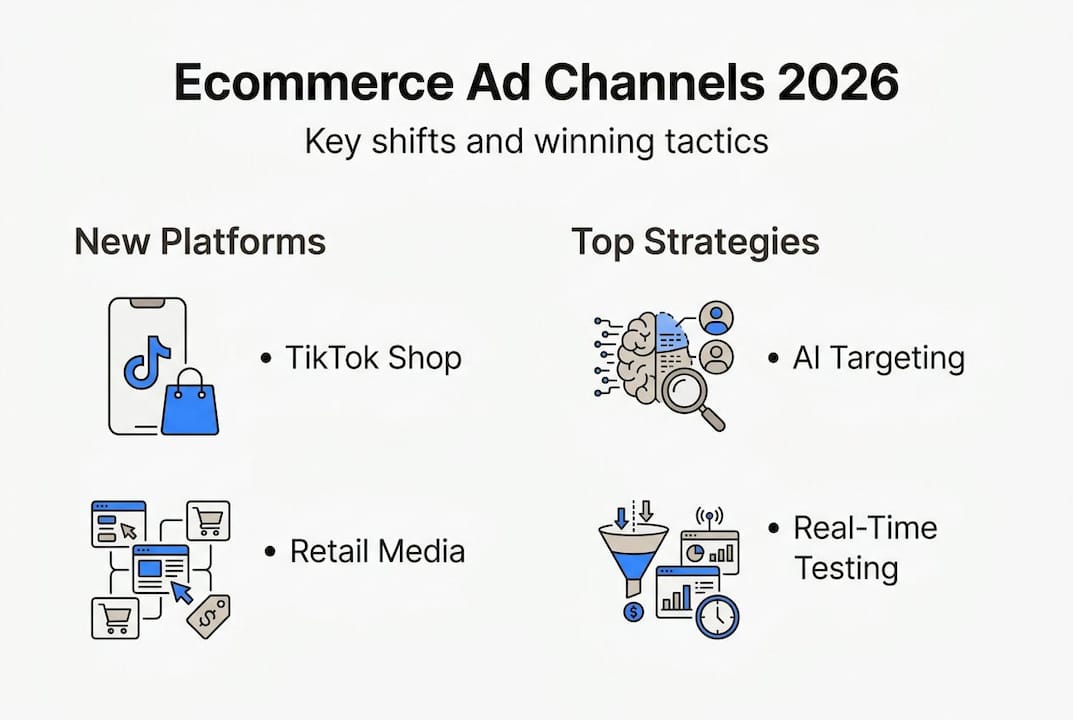
Ad dollars are not disappearing. They are relocating. As diversification beyond traditional media becomes a strategic priority, brands are exploring a wider set of channels with distinct strengths and tradeoffs.
Here is a comparison of the platforms gaining traction in 2026:
| Platform | Strength | Weakness | Best for |
|---|---|---|---|
| TikTok Shop | Native commerce, high engagement | Younger demographic skew | Fashion, beauty, lifestyle |
| High purchase intent, visual discovery | Smaller scale | Home, decor, apparel | |
| Retail media networks (Walmart, Target) | Closed-loop attribution | High CPMs, limited creative control | CPG, household goods |
| Connected TV (CTV) | Brand awareness at scale | Harder to measure direct ROAS | Mid-to-large brands |
| Creator/influencer networks | Trust, authenticity | Variable performance | DTC brands with strong story |
The most effective approach in 2026 combines two or three of these channels rather than betting everything on one alternative. Direct-to-consumer brands are also building private audiences through email, SMS, and loyalty programs to reduce platform dependency altogether.
Steps for smart channel diversification:
- Audit your current channel mix and identify over-concentration risk
- Select one or two emerging platforms aligned with your audience demographics
- Run a 30-day test with a modest budget and dedicated creative assets
- Evaluate performance against your existing channel benchmarks
- Scale winners and cut underperformers without sentiment
Pro Tip: AI-powered contextual placement tools can identify where your target audience is spending time outside the major platforms, often surfacing opportunities that manual research misses entirely.
For a detailed breakdown of how AI tools compare for managing multi-channel campaigns, the AI ad tool comparison on Larven’s blog is a useful reference point.
With new platforms in focus, it’s critical to understand how AI is supercharging campaign management.
AI-driven campaign strategies for 2026
AI is no longer a feature add-on for ecommerce advertising. It is the operational backbone for brands that want to compete at scale without proportionally scaling their team or budget.

The most impactful AI applications in 2026 fall into three categories:
Micro-segmentation and predictive targeting. AI models can analyze purchase history, browsing behavior, and contextual signals to build audience segments far more precise than traditional demographic targeting. Instead of targeting “women aged 25 to 34 interested in fitness,” a predictive model targets users who purchased activewear in the last 60 days, browsed protein supplements, and responded to video ads over static images.
Automated creative production and testing. Generating and testing ad creatives manually is slow and expensive. AI platforms can produce dozens of creative variations from a single product feed, test them in real time, and automatically allocate budget to top performers. Brands implementing AI in their ad strategies are seeing measurable improvements in campaign efficiency, particularly in reducing the time between creative concept and live deployment.
Real-time optimization and auto-budget allocation. AI campaign management tools monitor performance signals continuously, shifting budget between ad sets, audiences, and placements without waiting for a weekly review cycle. This matters enormously in volatile auction environments where CPMs can shift by 30% or more within a single day.
| AI capability | Manual approach | AI-powered approach |
|---|---|---|
| Creative production | 3 to 5 days per batch | Hours from product feed |
| A/B testing | Weekly review cycles | Continuous real-time testing |
| Budget allocation | Manual adjustments | Automated by performance signals |
| Audience segmentation | Broad demographic buckets | Predictive micro-segments |
Pro Tip: Connect your product catalog directly to your AI campaign tool. Platforms like Larven automatically prioritize best-selling products and refresh creatives before fatigue sets in, keeping ROAS stable without manual intervention.
Knowing the techniques is one thing. Measuring their effectiveness is another. Next, let’s see how to benchmark and optimize your results.
Measuring, iterating, and staying ahead
Strategy without measurement is guesswork. In 2026’s fragmented ad landscape, the brands winning are those with tight feedback loops and a culture of rapid experimentation.
Start by setting channel-specific KPIs rather than applying a single ROAS target across every platform. A TikTok campaign driving top-of-funnel awareness has different success metrics than a retargeting campaign on Meta. Conflating them produces misleading data and bad decisions.
A practical framework for iteration:
- Define KPIs per channel: ROAS, CPA, CTR, view-through rate, or engagement rate depending on campaign objective
- Set a testing cadence: Run new creative variations every 7 to 14 days to prevent fatigue and gather fresh performance data
- Establish a kill threshold: If a creative or audience segment underperforms by more than 20% below target after 5 days, pause it and reallocate budget
- Review attribution models: Last-click attribution undervalues upper-funnel channels. Use data-driven attribution or multi-touch models for a complete picture
- Document learnings: Every test should produce a documented insight that informs the next round of creative or targeting decisions
“CMOs exploring new channels rely on fast feedback and iteration to maximize impact, treating every campaign as a learning opportunity rather than a fixed execution.”
Building internal agility is as important as the tools you use. Teams that can brief, produce, launch, and analyze a campaign in under a week will consistently outpace those locked into monthly planning cycles. If you want early access to tools built for this speed, the waitlist for new ad tools from Larven is worth exploring.
Armed with these frameworks, let’s zoom out for a fresh perspective on how to truly thrive in this rapid transformation.
Why ‘diversify fast, learn faster’ wins in 2026
Here is an uncomfortable truth: most ecommerce brands are not failing because they lack strategy. They are failing because they are optimizing the wrong thing. They are refining campaigns on platforms that are structurally declining while treating experimentation as a risk rather than a requirement.
Legacy platforms are comfort zones. The data is familiar, the interfaces are known, and the results are predictable, even when those results are getting worse quarter over quarter. The real risk in 2026 is not testing a new channel and failing. It is staying put while the floor drops out.
Automated tools change the calculus entirely. When AI handles creative production, A/B testing, and budget allocation, the cost of running a new channel test drops dramatically. You can run five channel experiments simultaneously for the budget that once funded a single manual campaign. Failure becomes cheap. Learning becomes fast.
Brands that win are not the ones with the biggest budgets. They are the ones measuring relentlessly, iterating without ego, and using AI to compress the time between insight and action. Explore more case studies to see how brands are putting this into practice today.
How Larven helps you stay ahead
Adapting to 2026’s ecommerce ad landscape requires tools that move as fast as the market does. Larven is built for exactly this environment, automating creative production, managing Meta and TikTok campaigns from your product catalog, and continuously optimizing for ROAS without manual oversight.
Whether you are shifting budget to new platforms or scaling what already works, Larven functions as an AI CMO for ecommerce, handling the execution so your team can focus on strategy. Browse real results with Larven to see how brands are improving campaign efficiency, and join the waitlist to get early access to the next generation of AI-powered ad tools built for 2026’s landscape.
Frequently asked questions
What is agentic commerce and its impact on ecommerce ads?
Agentic commerce uses AI agents to automate buyer journeys, completing purchases without consumers ever interacting with traditional ad formats. Agentic commerce cuts retail media revenue by an estimated 20%, forcing brands to diversify beyond Google, Meta, and Amazon.
How can brands choose new advertising channels wisely in 2026?
Brands should run structured 30-day tests on emerging platforms with dedicated budgets and clear KPIs, then scale based on data rather than intuition. With 86% of CMOs experimenting with new channels, the competitive advantage goes to those who test earliest and iterate fastest.
Why is AI critical for campaign success in 2026?
AI enables micro-segmentation, automated creative testing, and real-time budget optimization at a speed and scale that manual management cannot match. Brands implementing AI in their ad strategies consistently see measurable improvements in campaign efficiency and ROAS.
How often should campaigns be iterated in the changing landscape?
The most effective brands iterate creative and targeting weekly, using real-time AI analytics to identify underperformers quickly and reallocate budget before significant spend is wasted.
Recommended
Turn this into a live campaign.
Tell Atlas what you're promoting and watch the batch appear.