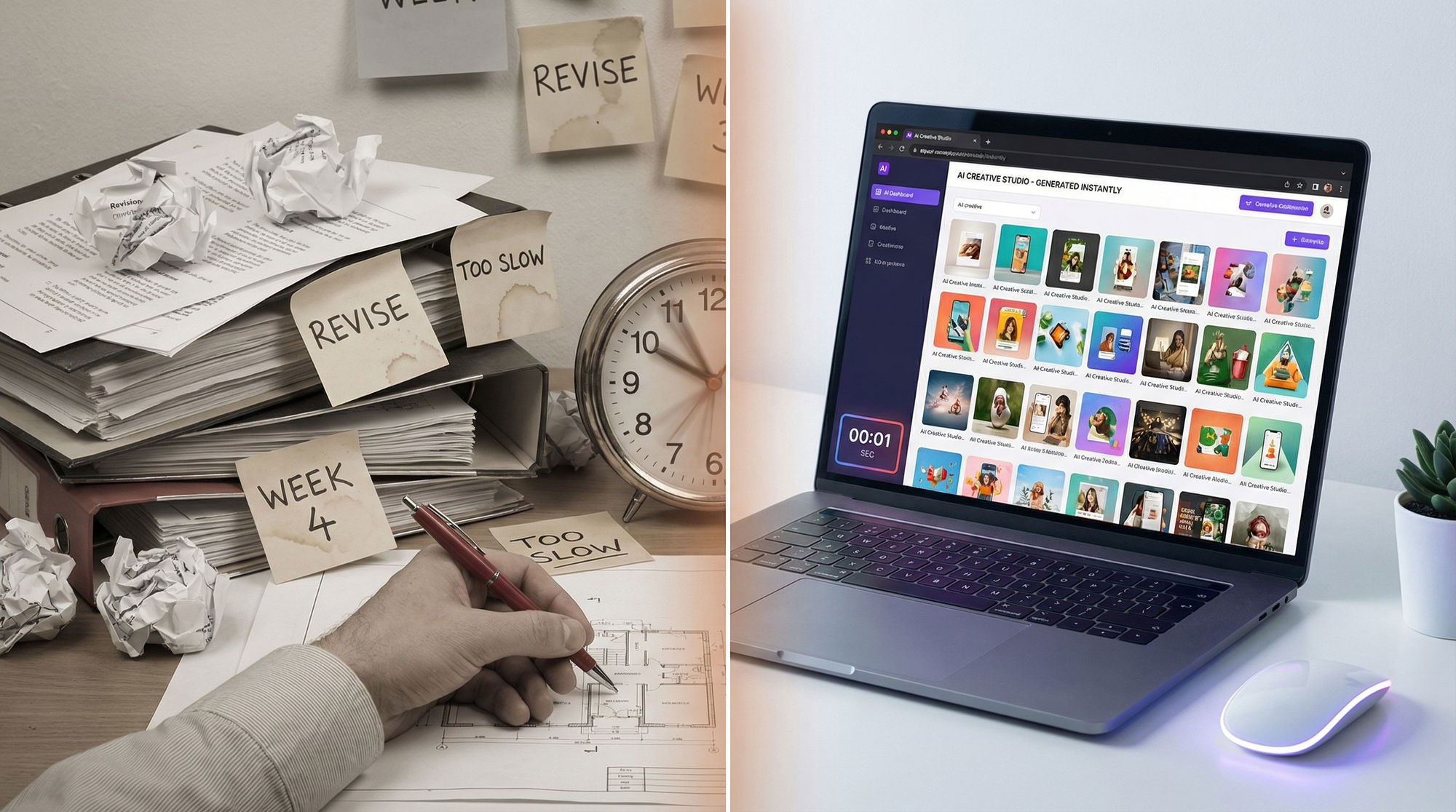
Most ecommerce brands know their ad creative is expensive. Few know exactly how expensive. When you add up the agency retainers, freelancer invoices, revision cycles, internal review time, format resizing, and the opportunity cost of slow deployment, the true cost of producing ad creative manually is 3x to 5x what appears on a single invoice. In 2026, where platforms like Meta and TikTok demand weekly creative refresh to sustain ROAS, this cost compounds fast. This guide quantifies every layer of manual creative production cost, compares it against AI-powered alternatives, and gives you a framework for calculating your own creative production ROI.
Table of Contents
- The visible costs: What shows up on invoices
- The hidden costs: What never makes the spreadsheet
- Time-to-launch: The cost nobody tracks
- AI creative production: A cost comparison
- Calculating your creative production ROI
- Why the real cost is the campaigns you never ran
- How Larven cuts creative production costs by 80%
- Frequently asked questions
Key Takeaways
| Point | Details |
|---|---|
| Manual creative costs 3x to 5x the invoice | Revision cycles, internal review, format resizing, and deployment delays multiply the visible cost. |
| Time-to-launch is the biggest hidden cost | A 2-week production cycle means 2 weeks of campaigns running stale creative at declining ROAS. |
| AI cuts production costs by 80% | Catalog-connected AI tools produce and deploy ad creatives in hours instead of weeks. |
| The real loss is untested ideas | Manual production limits you to 3 to 5 concepts per month. AI lets you test 30 to 50. |
The visible costs: What shows up on invoices
The direct costs of manual ad creative production are the ones most brands track. They are real, they are significant, and they are only part of the picture.
| Production method | Monthly cost estimate | Output volume |
|---|---|---|
| Full-service agency | $3,000 to $10,000+ | 10 to 20 assets per month |
| Freelance designer + videographer | $1,500 to $4,000 | 8 to 15 assets per month |
| In-house creative hire (full-time) | $4,000 to $7,000 (salary + tools) | 15 to 25 assets per month |
| UGC creators (5 to 10 per roster) | $1,000 to $3,000 | 5 to 10 videos per month |
A mid-sized ecommerce brand running Meta and TikTok campaigns simultaneously and refreshing creative weekly needs roughly 30 to 40 new assets per month. Using an agency for this volume means $5,000 to $10,000 per month minimum. A combination of freelancers and UGC creators brings that to $3,000 to $6,000. An in-house hire plus tools and UGC budget lands around $5,000 to $8,000.
These are the costs that show up on a profit and loss statement. They are not the full story.
The hidden costs: What never makes the spreadsheet
The most expensive parts of manual creative production never appear on a single invoice. They are distributed across your team's time, your campaign performance, and your competitive position.
Revision cycles. The average agency delivery goes through 2 to 3 rounds of revisions before approval. Each round takes 24 to 72 hours. For a batch of 10 creatives, revision cycles alone add 3 to 7 business days to the production timeline. Your team spends 5 to 10 hours per batch giving feedback, reviewing drafts, and managing communication.
Internal review and approval. Creative assets pass through brand review, legal compliance (especially for health, food, or finance verticals), and final sign-off. In organizations with more than one stakeholder, this adds another 1 to 3 days. The bottleneck is rarely the content itself. It is the calendar of the person who needs to approve it.
Format resizing. A single creative concept needs to exist in multiple formats: 1:1 for Facebook Feed, 9:16 for Stories and Reels, 4:5 for Instagram Feed, and landscape for certain placements. Resizing is often treated as a separate task, billed separately, and delivered on a separate timeline. For a batch of 10 creatives, resizing into 3 formats means 30 final assets that need individual quality checks.
Platform-specific adaptation. What works on Meta does not work on TikTok. A polished brand video needs to be re-edited with hooks, native text overlays, and a different pacing structure for TikTok. This is not a resize. It is a re-edit, often billed at 50% to 75% of the original production cost.
Communication overhead. Emails, Slack messages, project management updates, briefing calls, and feedback loops with external partners consume 8 to 15 hours per month of your team's time. At a marketing manager's loaded hourly cost, that is $400 to $1,000 per month in hidden labor.
| Hidden cost category | Time impact | Estimated monthly cost |
|---|---|---|
| Revision cycles (2 to 3 rounds per batch) | 3 to 7 days per batch | $500 to $1,500 in team time |
| Internal review and approval | 1 to 3 days per batch | $300 to $800 in team time |
| Format resizing (3+ formats per asset) | 2 to 4 days per batch | $500 to $1,500 in production fees |
| Platform-specific adaptation | 3 to 5 days per batch | $1,000 to $3,000 in re-edit fees |
| Communication overhead | 8 to 15 hours per month | $400 to $1,000 in team time |
When you stack these hidden costs on top of the visible invoice, the total monthly cost of manual creative production for a mid-sized ecommerce brand ranges from $6,000 to $15,000. And that is before accounting for the biggest cost of all: time.
Time-to-launch: The cost nobody tracks
The gap between creative concept and live deployment is the most expensive metric in ecommerce advertising, and almost nobody tracks it.
A typical manual production cycle:
- Creative briefing: Day 1
- First draft delivery: Day 4 to 7
- Revision round 1: Day 8 to 10
- Revision round 2: Day 11 to 13
- Format resizing and adaptation: Day 14 to 16
- Internal approval: Day 17 to 18
- Upload and campaign setup: Day 19
That is roughly 2.5 to 3 weeks from idea to live ad. During those 3 weeks, your existing campaigns are running on creatives that are aging out. If your current assets hit fatigue at day 7 (which is standard on both Meta and TikTok), you have 2 full weeks of campaigns running at declining performance while you wait for replacements.
The ROAS impact is direct and measurable. A campaign running stale creative for 14 extra days typically sees a 20% to 35% decline in ROAS compared to its peak. On a $5,000 monthly ad budget, that translates to $1,000 to $1,750 in wasted spend. On a $20,000 budget, it is $4,000 to $7,000.
"The most expensive ad creative is the one that arrives two weeks late. By the time it goes live, the campaign has already bled performance on stale assets."
AI creative production: A cost comparison
AI-powered creative platforms compress the entire production cycle from weeks to hours. Here is a direct comparison across every dimension that matters.
| Dimension | Manual production | AI-powered production |
|---|---|---|
| Monthly cost (30 to 40 assets) | $6,000 to $15,000 | $99 to $499 (platform subscription) |
| Time from concept to live ad | 2.5 to 3 weeks | Same day |
| Revision cycles | 2 to 3 rounds, 3 to 7 days | Instant regeneration |
| Format resizing | Separate task, 2 to 4 days | Automatic, one click |
| Platform adaptation (Meta to TikTok) | Re-edit, 3 to 5 days, 50% to 75% extra cost | Native format generation per platform |
| Creative variations testable per month | 10 to 20 | 50 to 100+ |
| Communication overhead | 8 to 15 hours per month | Near zero |
The cost reduction is not 20% or 30%. It is 80% or more when you account for the full loaded cost including hidden expenses and ROAS impact from slow deployment. For a detailed comparison of the AI tools available, the AI ad tool comparison on Larven's blog breaks down how different platforms handle creative generation, testing, and deployment.
Pro Tip: When calculating ROI on an AI creative platform, include the ROAS improvement from faster deployment, not just the production cost savings. For most brands, the ROAS uplift from eliminating the 2-week production gap is worth more than the direct cost reduction.
Calculating your creative production ROI
Use this framework to calculate the total cost of your current creative production and compare it against an AI alternative.
Step 1: Total visible cost. Add up all monthly invoices for creative production: agency fees, freelancer payments, UGC creator fees, stock asset licenses, and tool subscriptions used by your creative team.
Step 2: Hidden cost multiplier. Estimate the monthly hours your team spends on briefing, reviewing, approving, and managing creative production. Multiply by your team's loaded hourly rate. Add format resizing and platform adaptation fees.
Step 3: ROAS decay cost. Calculate your average monthly ad spend. Estimate how many days per month your campaigns run on fatigued creative (any day past the 7-day refresh threshold). Multiply those days by your estimated daily ROAS decline percentage (typically 3% to 5% per day past fatigue) and your daily spend.
Step 4: Total loaded cost. Sum steps 1 through 3. This is your true monthly creative production cost.
Step 5: Compare. Place your AI platform subscription cost alongside this total. The difference is your monthly savings potential.
| Cost component | Your estimate |
|---|---|
| Visible production costs (invoices) | $________ |
| Hidden team time costs | $________ |
| Format resizing and adaptation fees | $________ |
| ROAS decay from slow deployment | $________ |
| Total loaded monthly cost | $________ |
| AI platform monthly cost | $________ |
| Monthly savings | $________ |
For most mid-sized ecommerce brands spending $5,000 to $20,000 per month on ads, the total loaded creative production cost represents 30% to 60% of their ad budget. Cutting that by 80% frees significant capital for actual media spend, directly increasing the reach and frequency of winning campaigns.
Why the real cost is the campaigns you never ran
The hardest cost to quantify is the one you never see: the creative concepts that never got tested because production capacity was the bottleneck.
When your team can only produce 10 to 15 new assets per month, every creative decision carries high stakes. You default to safe, proven formats because there is no room for experimentation. A new hook angle, an untested product focus, a different visual style: these ideas die in a backlog because the production pipeline is already at capacity with scheduled refresh work.
AI creative tools flip this dynamic. When production is measured in hours instead of weeks, the cost of testing a new idea approaches zero. You can run 5 hook variations, 3 format experiments, and 2 new product angles in the same time it would have taken to produce a single batch manually. The compounding effect of this testing velocity over 3 to 6 months creates a creative data advantage that competitors relying on manual production simply cannot replicate.
For a broader view of how leading brands are building this creative velocity, the content creation for automated ads guide on Larven's blog covers the full operational framework.
How Larven cuts creative production costs by 80%
Larven connects to your product catalog, generates image, video, and UGC-style ad creatives automatically, resizes for every placement, and deploys directly to Meta and TikTok. The entire cycle from product data to live ad takes hours, not weeks.
For ecommerce brands tired of overpaying for creative that arrives too slowly, Larven functions as an AI CMO that eliminates the production bottleneck entirely. See real results from brands using Larven, or join the waitlist to get early access and start cutting your creative costs immediately.
Frequently asked questions
How much does manual ad creative production really cost?
When you include visible costs (agency fees, freelancers, UGC creators) and hidden costs (revision cycles, internal review time, format resizing, platform adaptation, and ROAS decay from slow deployment), the total loaded cost for a mid-sized ecommerce brand ranges from $6,000 to $15,000 per month.
How does AI reduce creative production costs by 80%?
AI platforms eliminate revision cycles, automate format resizing, generate platform-native creative directly from your product catalog, and compress the production timeline from weeks to hours. The subscription cost of $99 to $499 per month replaces $6,000 to $15,000 in loaded manual production costs.
What is the ROAS impact of slow creative production?
Campaigns running stale creative beyond the 7-day fatigue threshold typically see a 20% to 35% ROAS decline. A 2-week production delay means 2 weeks of declining performance, costing $1,000 to $7,000+ in wasted spend depending on your monthly ad budget.
Can AI creative tools match agency quality?
For performance advertising where conversion metrics matter more than brand prestige, AI-generated creative consistently matches or outperforms agency work because it is built for platform-native formats and refreshed at the velocity algorithms demand. The testing volume advantage compounds this gap over time.
Recommended
Turn this into a live campaign.
Tell Atlas what you're promoting and watch the batch appear.