
Ad creative has a short shelf life on Meta and TikTok, and in 2026, that window is shrinking faster than most marketing teams can keep up with. Audiences scroll past familiar visuals in seconds, and platform algorithms reward novelty by throttling spend on stale assets. The result is a familiar pattern: a campaign launches strong, then quietly bleeds performance over two to three weeks until the numbers force a reaction. A creative-first strategy with weekly refresh cycles built around broad targeting and full-funnel deployment is now the standard for brands that sustain ROI at scale. This guide walks you through every layer of that approach.
Table of Contents
- Understanding the creative-first content strategy
- Essential tools and requirements for 2026 content creation
- Step-by-step content creation for automated ad campaigns
- Common mistakes and troubleshooting content automation
- Measuring success: Key metrics and optimization tactics
- Why e-commerce content creation is all about speed and iteration in 2026
- Supercharge your content creation with Larven AI
- Frequently asked questions
Key Takeaways
| Point | Details |
|---|---|
| Weekly refresh is essential | Updating creatives every 7 days keeps automated campaigns performing their best. |
| Use automation tools | Leverage AI and integrated platforms to scale your content creation and deployment. |
| Measure and optimize | Track KPIs like CTR and creative fatigue weekly to stay ahead of ad performance drops. |
| Avoid common pitfalls | Watch for over-narrow targeting and stale assets to prevent wasted spend. |
| Speed beats perfection | Iterate quickly to outpace competitors and drive superior results in 2026. |
Understanding the creative-first content strategy
A creative-first strategy places ad content at the center of campaign decision-making, rather than treating it as a deliverable that follows media planning. In practice, this means the creative brief, production cadence, and refresh schedule drive how budgets are allocated and how campaigns are structured. Traditional approaches often lock in a set of assets for a full month or longer, then optimize around audience segments and bid strategies. That model breaks down quickly inside automated ad environments where algorithms need continuous signal variety to find new buyers.
Meta’s Advantage+ and TikTok’s Smart Performance campaigns are designed to test multiple creatives simultaneously and shift spend toward what converts. When the creative pool is thin or stale, the algorithm has nowhere to go. Weekly asset refresh keeps the algorithm fed and prevents any single asset from exhausting its audience segment. Seven days is the practical ceiling before frequency starts working against you on most e-commerce accounts.
Creative variety also directly affects how far your budget can scale. A single winning video can carry a campaign to a point, but it creates a ceiling. Introducing new angles, formats, and hooks weekly raises that ceiling by giving the platform more entry points into different audience subsets. You can explore modern content creation methodologies that automate this variety at scale without proportionally increasing production overhead.
The benefits of a creative-first approach are concrete and measurable:
- Reduced audience fatigue by rotating fresh assets before frequency thresholds are hit
- Improved ROAS through continuous algorithm signal from new creative combinations
- Greater discoverability as new hooks reach cold audiences that previous creatives missed
- Lower CPM over time because fresh content earns higher relevance scores on both platforms
- Faster learning cycles that surface winning concepts in days rather than weeks
Pro Tip: Set a calendar reminder every Monday to audit your top five active creatives. If any asset has run for more than seven days with declining CTR, flag it for replacement before the algorithm starts deprioritizing the entire ad set.
Reviewing AI advertising strategy trends alongside your own data helps calibrate how aggressively you need to refresh based on your vertical and average order value.
Essential tools and requirements for 2026 content creation
AI-driven platforms have moved from optional to essential for any team running automated campaigns at meaningful scale. The manual alternative, briefing a designer or agency every week, simply cannot match the cadence that modern platform algorithms demand. Here is a comparison of the core tool categories you need in your stack:

| Tool category | Primary function | Key capability in 2026 |
|---|---|---|
| AI creative generation | Produce image, video, and UGC-style ads | Catalog-connected asset creation |
| Asset management | Organize, version, and approve creatives | Automated tagging and expiry alerts |
| Analytics dashboard | Track creative performance by format | Creative fatigue rate monitoring |
| UGC collection platform | Source and license creator content | Automated outreach and rights management |
| Multi-format resizer | Adapt assets for each placement | One-click resize for Stories, Reels, Feed |
Beyond tools, the skill set required to run this process has shifted. Creative direction now means writing precise prompts for AI generation tools, not just briefing human designers. Data analysis is no longer a weekly reporting task but a daily input that determines which assets get produced next. You can benchmark your current stack against a detailed AI ad tool comparison to identify gaps.
Essential software categories for 2026 include:
- Creative generation platforms with native catalog integrations for e-commerce product feeds
- A/B testing frameworks built into the ad platform or layered on top via third-party tools
- UGC pipeline tools that automate creator outreach, content collection, and usage rights
- Centralized asset libraries with metadata search so production teams can reuse winning elements
Pro Tip: Build your UGC pipeline before you need it. Waiting until a campaign underperforms to start sourcing creator content adds two to three weeks of delay. Maintain a rolling roster of five to ten creators who can turn around content within 48 hours.
Step-by-step content creation for automated ad campaigns
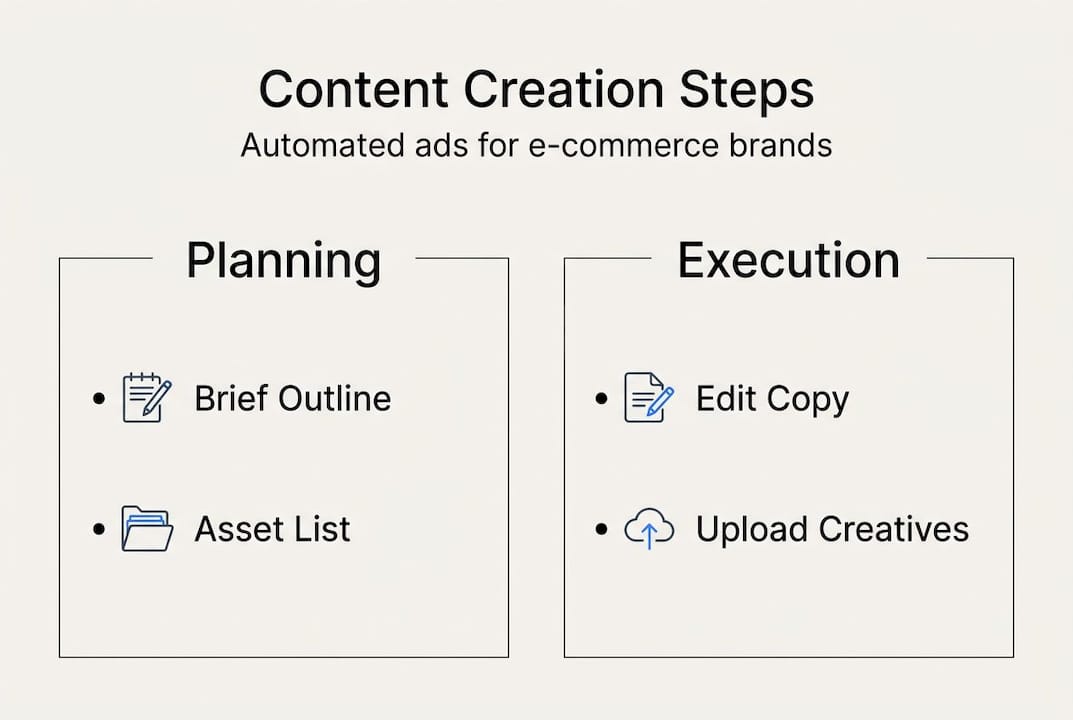
With your tools and team structure in place, the production workflow follows a repeatable sequence. Each phase has a clear owner and a defined output, which prevents the bottlenecks that stall most content operations.
- Ideation. Pull your top-performing organic content from TikTok and Meta, identify the hooks and formats that drove the most engagement, and use those patterns to brief your next creative batch. Data should drive ideation, not intuition alone.
- UGC and asset sourcing. Brief creators or your AI generation platform with specific hooks, product angles, and format requirements. For AI-generated assets, connect your product catalog so the tool can pull accurate imagery and copy automatically.
- Creative approval. Run a lightweight review cycle. The goal is catching brand compliance issues, not perfecting every frame. A 24-hour approval window keeps the weekly cadence intact.
- Automated deployment. Upload approved assets to your campaign structure. For top-of-funnel (TOF) campaigns, load new creatives into Meta Advantage+ or TikTok Spark Ads, which use creator-authorized content to run as native-feeling placements. For bottom-of-funnel (BOF) retargeting, use dynamic product ads that pull from your catalog automatically.
- Measurement. After 72 hours, check CTR, cost per purchase, and frequency. Assets that underperform against your benchmarks get paused. Winners stay live until the seven-day mark.
A full-funnel approach with TOF and BOF maximizes creative effectiveness because each stage of the funnel serves a different audience intent. TOF content needs to stop the scroll and create awareness. BOF content needs to close the sale with urgency and specificity. Mixing these objectives into a single creative type is one of the most common structural errors in automated campaigns.
Pro Tip: Avoid asset validation bottlenecks by pre-approving a creative template library. When your team works within approved templates, the review cycle shrinks from 24 hours to under two hours. Explore autonomous content generation tools that build within brand-safe parameters from the start.
Common mistakes and troubleshooting content automation
Even a well-designed creative system runs into predictable problems. Knowing what to look for cuts recovery time significantly.
Common mistakes include:
- Content fatigue from under-refreshing. Running the same creative past seven days on Meta or TikTok almost always results in frequency spikes and CPM increases. The fix is structural: build refresh into your weekly workflow, not as a reaction to declining numbers.
- Over-narrow audience targeting. Automated campaigns need room to find buyers. Tight interest stacks or small custom audiences limit the algorithm’s ability to optimize. Broad targeting with strong creative is consistently more effective than narrow targeting with average creative.
- Inadequate UGC volume. Relying on one or two creator videos for an entire month creates a single point of failure. If those assets fatigue, the campaign has nothing to fall back on.
- Skipping format diversification. Running only one format across all placements ignores how differently audiences behave in Stories versus Feed versus Reels.
Warning: Skipping your weekly creative refresh is the single fastest way to erode campaign performance. Broad targeting and frequent refreshes are the two levers that consistently counter declining ad performance. Letting either slide compounds the problem within days.
To monitor performance dips effectively, set automated rules inside Meta Ads Manager and TikTok Ads Manager that alert you when CTR drops more than 20% week over week or when frequency exceeds 2.5 per week. These thresholds are practical starting points for most e-commerce accounts. Reviewing AI video ad best practices can also surface format-specific fixes that apply directly to your account type.
Measuring success: Key metrics and optimization tactics
Tracking the right metrics is what separates reactive campaign management from a proactive creative system. Four KPIs matter most for content-driven e-commerce campaigns.
- CTR (click-through rate): Measures how effectively your creative stops the scroll and drives intent. A declining CTR on a stable audience is almost always a creative fatigue signal.
- ROAS (return on ad spend): The primary revenue efficiency metric. Creative quality directly impacts ROAS because better ads convert at lower cost per click.
- CPM (cost per mille): The cost to reach 1,000 impressions. Rising CPM on a consistent audience often indicates the algorithm is working harder to find receptive viewers, which signals creative exhaustion.
- Creative fatigue rate: The speed at which an asset’s CTR declines after launch. Tracking this per format and per funnel stage helps you predict refresh timing rather than react to it.
Regular measurement and optimization are what sustain ROI over time. The table below maps common performance signals to specific optimization actions:
| Performance signal | Likely cause | Optimization action |
|---|---|---|
| Low CTR | Weak hook or stale creative | Refresh creative with new hook |
| High CPM | Audience saturation | Broaden targeting or expand lookalikes |
| Low ROAS | Poor landing page or creative mismatch | Test new offer angle in creative |
| High frequency | Under-refreshed asset pool | Add three to five new creatives immediately |
Best-in-class benchmarks for 2026 on Meta sit around a 1.5% to 2.5% CTR for e-commerce, with ROAS targets varying by margin, typically 2x to 4x for most categories. TikTok benchmarks trend slightly lower on CTR but can deliver stronger ROAS for impulse-purchase products. Set up a weekly 30-minute review cycle every Monday to assess these metrics, make creative decisions, and brief the next batch of assets. You can also review measuring ad tool performance to understand how your current platform stacks up against alternatives.
Why e-commerce content creation is all about speed and iteration in 2026
The brands winning on Meta and TikTok right now are not necessarily the ones with the largest budgets or the most sophisticated targeting strategies. They are the ones producing and testing creative faster than anyone else. Speed of iteration has become a genuine competitive advantage, and it is one that compounds over time.
Every week a brand runs a new batch of creatives, it generates data that informs the next batch. Over 12 weeks, that is 12 rounds of learning that a slower competitor simply does not have. The gap widens quietly, and by the time a lagging brand notices the performance difference, the leader has already built a creative library and a testing methodology that is very difficult to replicate quickly.
Creative variety is now a moat. Not a moat built from proprietary technology or exclusive partnerships, but from the discipline of showing up every week with fresh angles, new formats, and better hooks. Embracing a weekly creative cycle, supported by AI advertising insights and automation, is how that moat gets built systematically rather than by accident.
Supercharge your content creation with Larven AI
Ready to apply these methods at scale? Larven AI is built specifically for e-commerce marketing managers who need to maintain a weekly creative cadence without expanding their production team. The platform connects directly to your product catalog, generates image, video, and UGC-style ad creatives automatically, and manages deployment across Meta and TikTok from a single interface.
Larven functions as an AI CMO for e-commerce, handling creative refresh, format resizing, and campaign optimization so your team can focus on strategy rather than production. Whether you are scaling a single brand or managing multiple product lines, the platform adapts to your catalog and your goals. See real results with Larven from brands already running automated creative cycles, or join the Larven waitlist to get early access to the full platform.
Frequently asked questions
What is creative fatigue in automated ad campaigns?
Creative fatigue occurs when ad audiences tire of seeing the same content, causing performance to drop until new creatives are introduced. It shows up as rising CPM, falling CTR, and declining ROAS on otherwise healthy campaigns.
How often should I refresh creative for Meta and TikTok ads?
A weekly creative refresh every seven days is the recommended cadence for keeping automated algorithms performing optimally and preventing audience saturation.
What are the most important KPIs for content-driven e-commerce campaigns?
The four essential KPIs are CTR, ROAS, CPM, and creative fatigue rate. Regular measurement of all four together gives a complete picture of creative health and campaign efficiency.
How do I automate content deployment across Meta and TikTok?
AI-driven platforms that connect to your product catalog can handle creative generation, scheduling, and deployment automatically, removing the manual bottlenecks that slow down weekly refresh cycles.
Recommended
Turn this into a live campaign.
Tell Atlas what you're promoting and watch the batch appear.